"I want to reach new audiences with flexible variants of my brand media."
Ad Media Editing
Role: Product design lead
Timeline: 6 months
Team: Product Design (3), Content (2), Engineering (5), Product Management, Data Science
Meta’s advertising ecosystem was evolving beyond single-asset campaign creation toward a more adaptive, flexible system with AI-powered creative variants. As automation capabilities expanded, advertisers needed workflows capable of supporting multiple media assets, formats, and placement variations simultaneously. Existing editing workflows, however, were still built around one-media-at-a-time customization models that created friction at scale.
The project redesigned media customization controls in Ads Manager to support multi-media editing, flexible creative variations, and placement-aware optimization workflows. Advertisers could now manage collections of images and videos within a system that automated selection and optimization across placements, audiences, and formats. The experience simplified complex creative workflows while enabling more scalable automation systems behind the scenes. The experience transformed media editing from a linear asset workflow into a more dynamic orchestration designed for large-scale ad delivery.
Impact snapshot
Advertisers
10M+
Daily impressions
50B+
New model
Multi-asset recipes
Enabled
Creative optimization

Context
Every day, billions of ad impressions are seen across Facebook, Instagram, Threads, and other Meta platforms. Each ad contains an image or video asset chosen by one of the over 10 million advertisers on the platform.
Media is uploaded, selected from a media library, and then customized for each impression. Media is cropped for specific aspect ratios of different ad placements, given custom text properties, and more.
This project was a fundamental shift in how advertisers interact with the media before publishing ads to their audiences, shifting from a single image or video model to a flexible creative “ingredients” model.

Challenge
The new mental model
For years, Ads Manager treated media customization as a one-to-one workflow: one image or video = one editing workflow = one output per ad experience. But Meta’s ad ecosystem had changed dramatically:
- More placements
- More aspect ratios
- More content formats
- More automation
- More AI-driven delivery systems
The original editing model became incompatible with how modern ad delivery worked behind the scenes. Advertisers were no longer creating a single ad creative. They were effectively creating a pool of creative possibilities that Meta’s systems could optimize dynamically. The product experience hadn’t caught up yet.
Problem
Mental model misalignment
Meta’s ads ecosystem was evolving toward a more dynamic future. Machine learning systems could identify high-performing creative combinations, but media customization flows treated each creative asset independently. Advertisers were required to manually edit assets one by one, and duplicate effort across multiple ads and placements. They were forced to think in terms of static outputs, which isn’t how the ad delivery system works.
As advertisers uploaded more assets, the workflow became increasingly difficult to manage. The system could not fully leverage performance signals across a broader creative pool, and advertisers optimized individual assets manually, while delivery systems optimized performance automatically behind the scenes.
The interaction model wasn’t built for future AI-assisted optimization systems, and introduced friction precisely where automation was becoming most valuable.
Opportunity
Multi-asset creative variants
The mental model shifted from “edit this image” to “add creative ingredients the system can use to create new recipes”. This required re-thinking everything about media interactions in ad creation flows.
- Media selection and uploading
- Creative customization
- Media > placement mapping
- Balancing control and automation
Because advertisers could now upload and manage pools of media assets, all in a single ad, the system could more effectively select dynamic media variants and combinations of creative assets.
Instead of manually defining every output, advertisers could enable the system to continuously identify higher-performing creative combinations.
Design goals
Simplicity
Enable advertisers to manage multiple assets without exponentially increasing customization effort.
Transparency
Automation needed to feel understandable and controllable, not opaque or complex.
Liquidity
Enable the delivery systems to identify more performant combinations of media, formats, and placements.
Scalability
Build a foundation that could support creative flexibility for increasingly adaptive ad systems.
The core advertiser experience
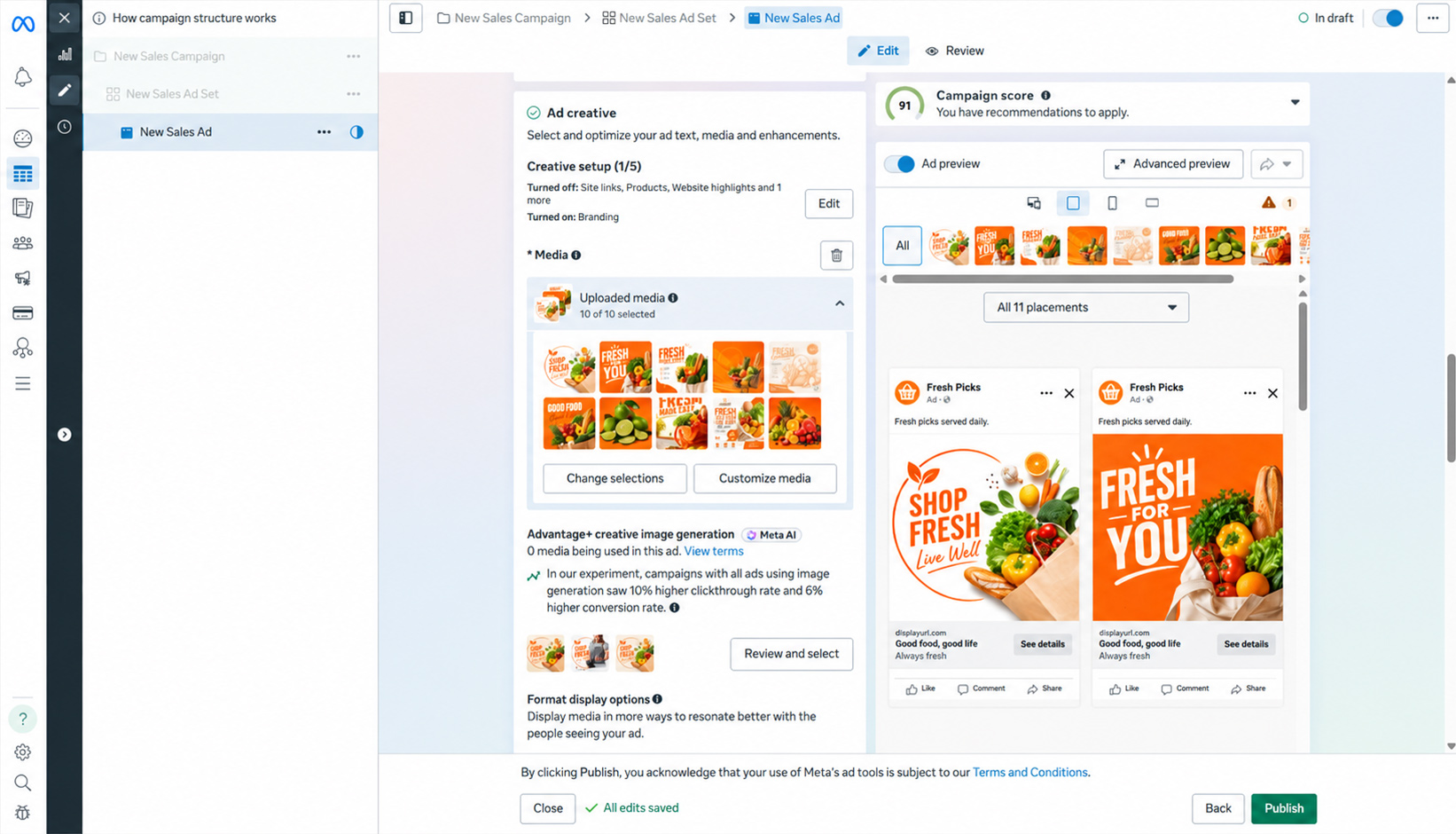
Enabling multiple media per ad improves creative liquidity and performance potential. Once media is uploaded, advertisers can preview ads across all placements.

Advertisers are guided through creation of optional AI-generated images and videos to diversify media assets and creative variants.
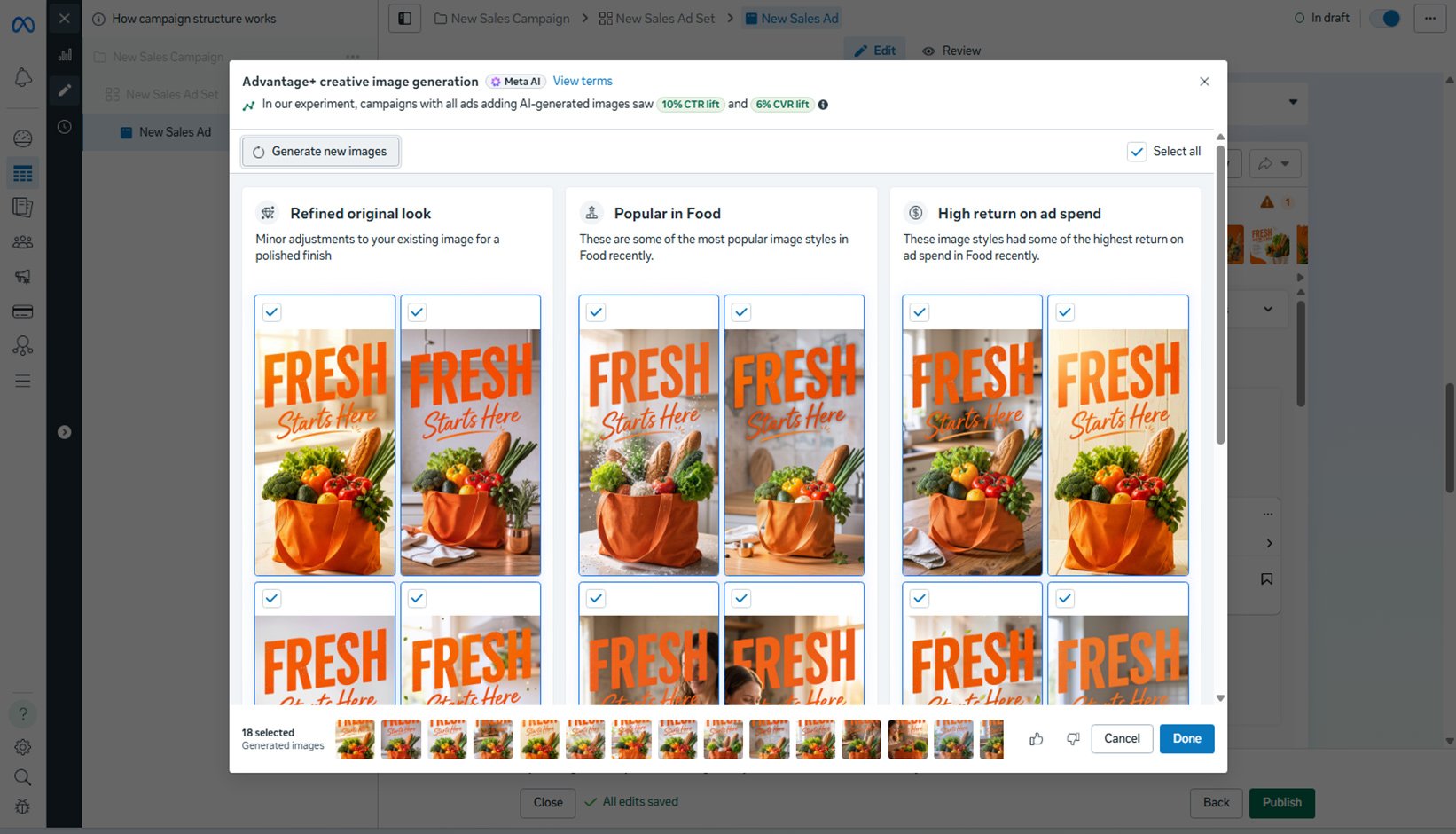
Media assets could now be treated as “ingredients” in recipes for variants of ad creative, and the machine learning system could find the best performing variations.
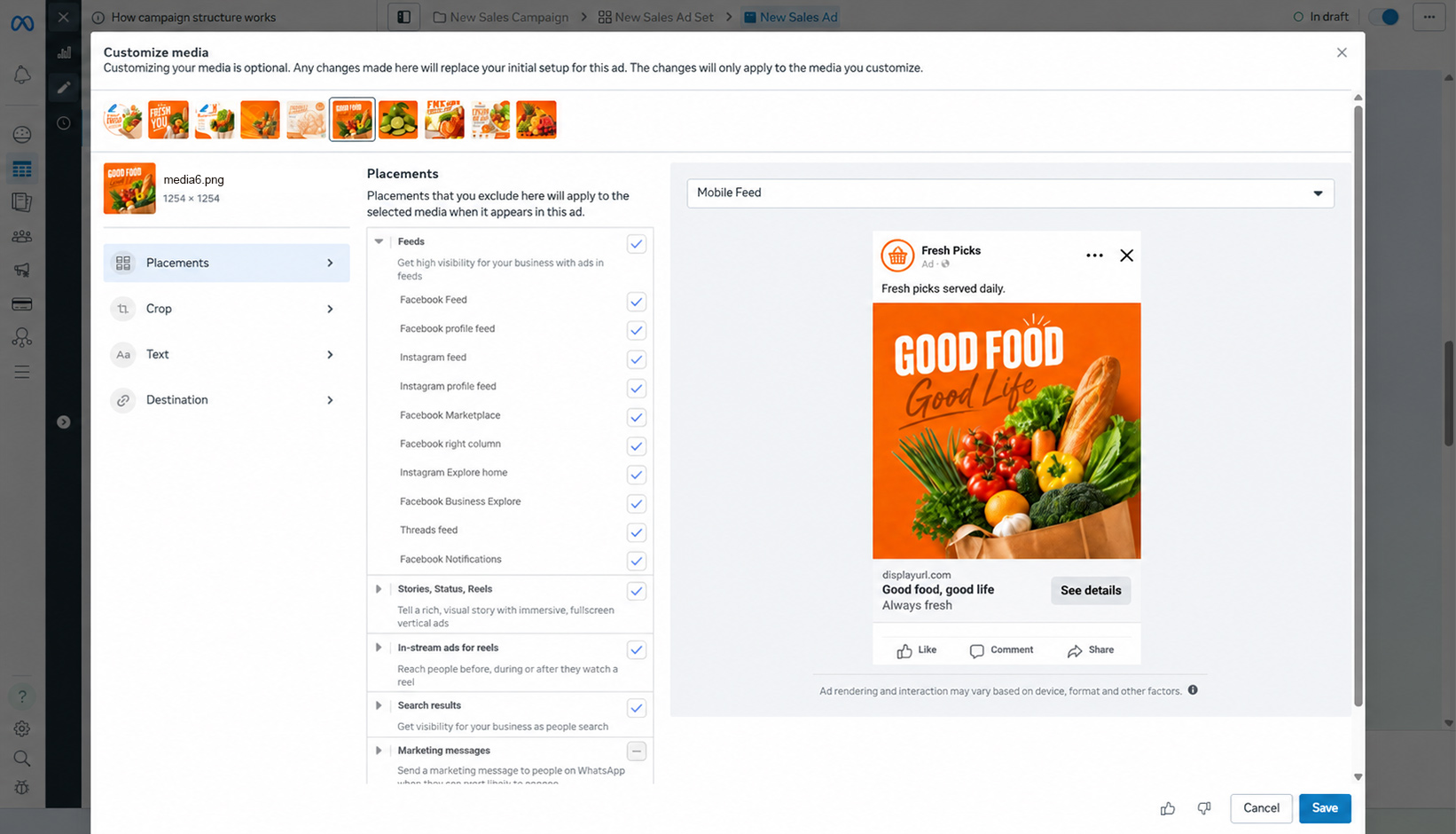
When variants of the same media are inputted, the system automatically groups them and maps them to the correct placements (e.g. vertical media to Reels, etc).
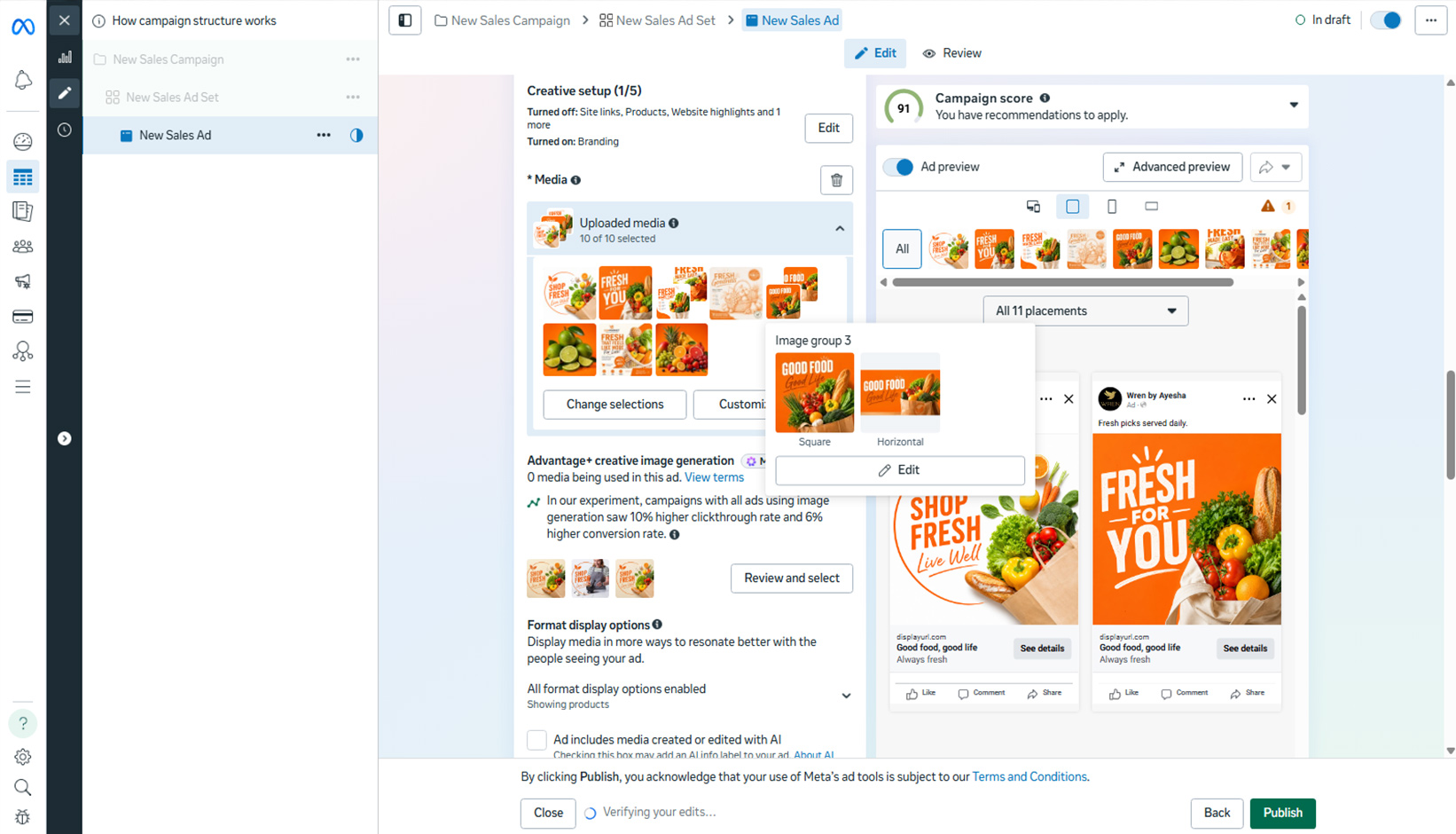
Media can be cropped to standard aspect ratios (square, vertical, horizontal) to prioritize how the system uses creative variants across different ad placements.
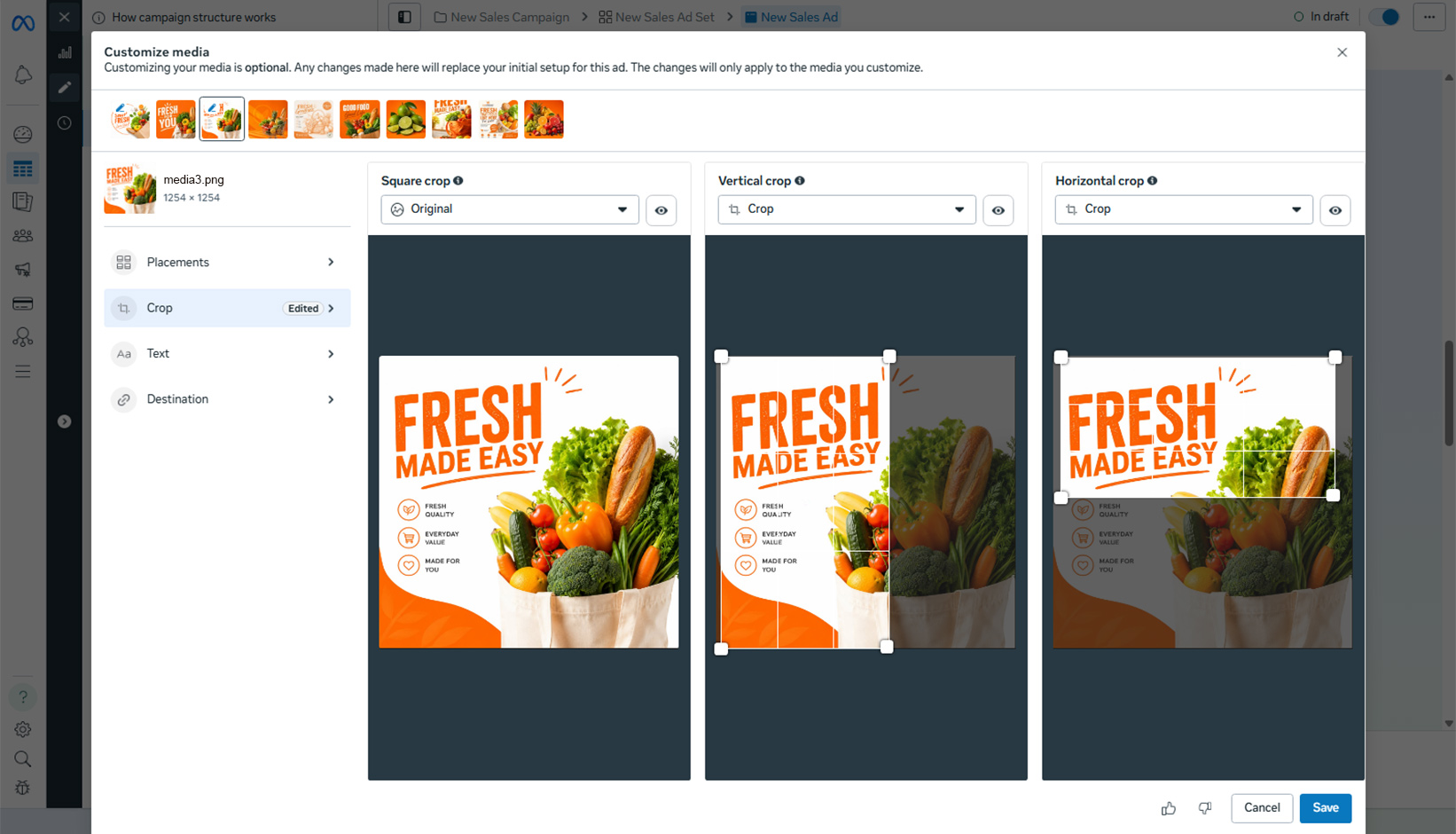
Media can be manually denoted for individual placements, or prevented from showing on certain placements entirely.
Outcomes
For advertisers
Scalable media customization
The transition from single-media editing to a multi-media customization system reduced operational friction across ad creation workflows. Advertisers could manage pools of creative assets instead of manually editing individual images and videos across placements, creating a more scalable and flexible workflow for a modern campaign creation that mirrors how the system uses creative assets.
For Meta
System optimization enablement
More work
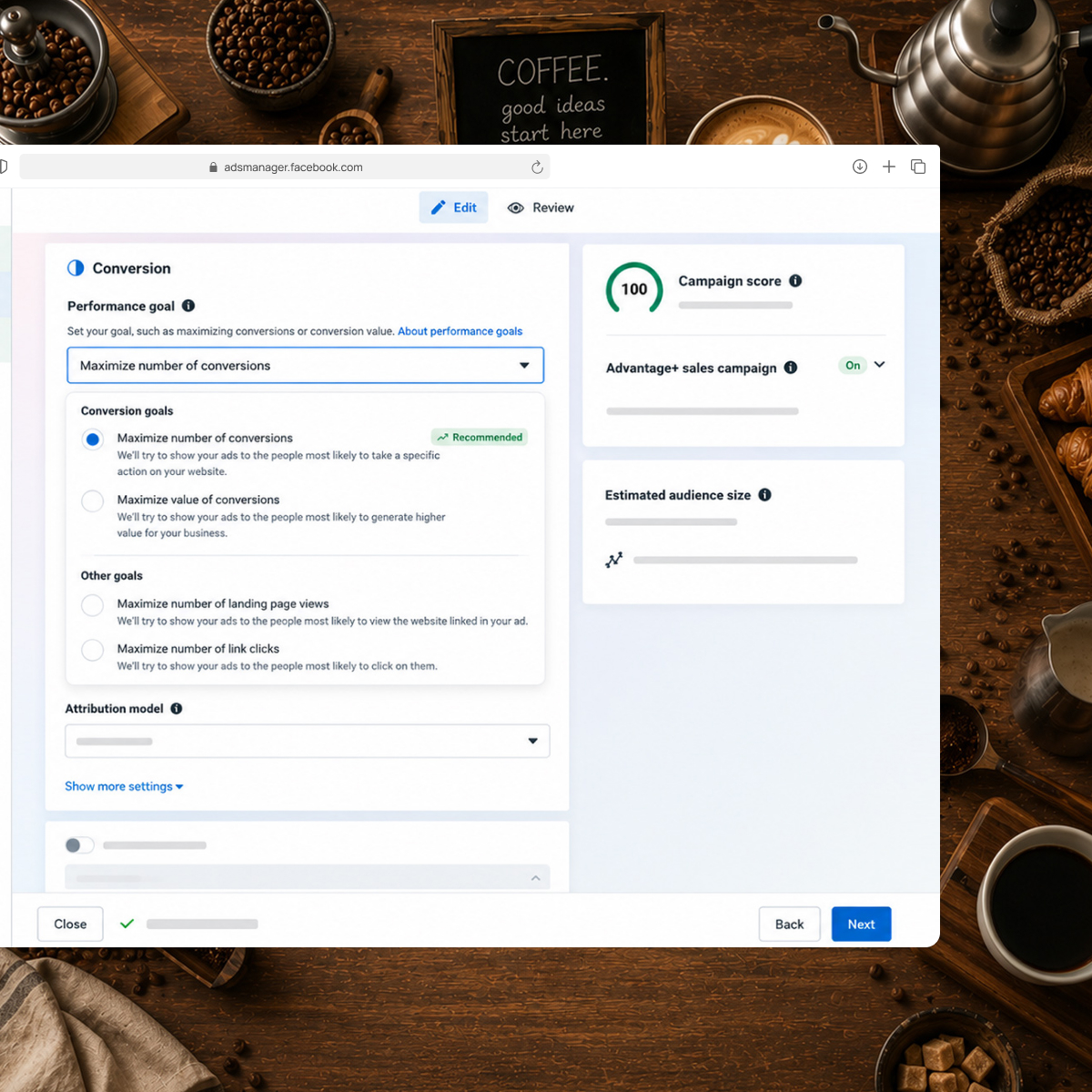
Goal Expression in Meta’s Ads Manager
Goal Expression in Meta’s Ads Manager
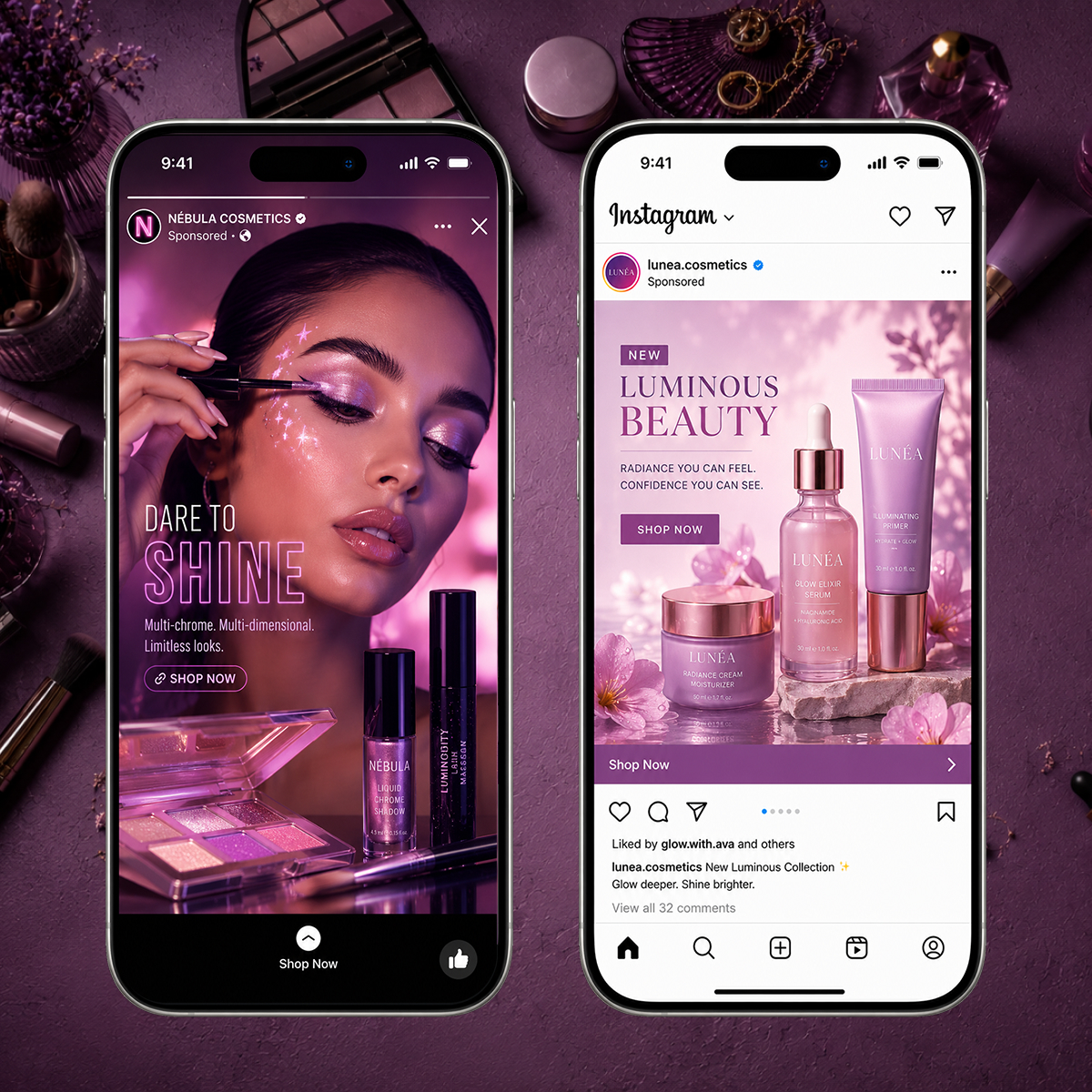
Ad Placement Settings in Meta’s Ads Manager
Ad Placement Settings in Meta’s Ads Manager

Campaign Scoring for Optimal AI-Powered Ad Performance
Campaign Scoring for Optimal AI-Powered Ad Performance

Ranking and Prioritization Framework