
"I want to grow my customer base and increase revenue for my business."
Goal Expression in Ads Manager
Advertisers think in outcomes. They want to acquire customers, increase sales, drive subscriptions, generate leads, or improve return on ad spend. Meta’s advertising systems, however, were built around delivery mechanics: conversion events, optimization goals, bidding strategies, attribution settings, budgets, and performance controls. The platform was built in a way that reflected how the delivery system worked, rather than how advertisers thought about achieving outcomes.
While these tools enabled sophisticated optimization, they created a fundamental disconnect between how advertisers thought about success and how campaigns were configured. As a result, many advertisers struggled to translate their business goals into effective campaign setups.
I led design efforts to explore a new framework for connecting business objectives, marketing goals, campaign configuration, and performance measurement into a more intuitive and scalable experience. Our team set out to answer a simple question:
What if advertisers could express their goals directly, and the platform could translate those goals into the right campaign configuration?
My role
- Product strategy
- Experience vision
- Information architecture
- Interaction design
- Prototyping
- Research synthesis
- Cross-functional alignment
Partnered with Content Design, Product Management, Research, Data Science, Engineering, and Product Marketing to define a new goal-oriented framework for campaign creation.
Problem
Nearly half of advertisers reported that they could not fully achieve their marketing goals through Meta’s ads, even though their goals were supported in the platform.

01: Complexity
Advertisers had low familiarity with Meta’s delivery systems and optimization models. Even experienced advertisers struggled to understand how performance controls interacted behind the scenes.

02: Fragmentation
Controls related to a single business objective were scattered across multiple surfaces. To express a simple goal like “drive profitable purchases from my website”, advertisers had to search for and configure multiple product levers.

03: Dependencies
Many controls contained hidden relationships and eligibility requirements. Changing one setting could have unexpected (and sometimes unexplainable) effects on others, making campaign creation feel unpredictable.
Research
To better understand how advertisers approached campaign setup, we conducted research focused on goal expression. One insight appeared consistently across sessions: advertisers rarely described goals using Meta’s terminology. They never said “I want conversion optimization for ad delivery using purchase events.” They said things like “I want to maximize purchases on my website,” or “I want the highest possible return from my budget.” The language advertisers naturally used was fundamentally different from the language required by the platform.
47
%
47% of advertisers weren’t optimizing campaigns toward their primary marketing objective.
85%
%
85% of advertisers made business decisions based on more than one KPI.
22
%
22% of advertisers made business decisions based on metrics that weren’t supported in product.
26
%
26% of advertisers were limited from sharing the data Meta needed to optimize for primary marketing goals.
18%
%
18% of advertisers defined successful advertising outcomes in ways that Meta did not measure.
25
%
25% of advertisers needed to optimize for more complex goals than Meta supported (pLTV, etc).
I identified a strategic opportunity to shift from configuration-first campaign setup to goal-first campaign setup. Instead of asking advertisers to select from a series of optimization products, we would simply ask them what they wanted to achieve, and let the system handle the complexity of configuring itself.
Advertiser mental model

Advertisers in research sessions rarely described their goals in terms of attribution windows or delivery optimization strategies. They described outcomes. They used human-centered language to describe business value.

From Meta’s perspective, this same simple goal statement represented multiple different products owned by different teams across organizational lines, building disconnected experiences independently.

Hypothesis
Advertisers will optimize for their true business goals if they no longer need to understand Meta’s optimization framework.
By combining multiple individual product settings into “combos” that represented complex goal setups, advertisers will be able to more easily configure new ad campaigns to drive their true business objectives.
Before:
- Use multiple fragmented products and complex configurations to try to drive true business goals.
After:
- Enter true business goal, and let the system’s built-in dependencies and deep knowledge handle the complexity of configuration.
Solution
We converted goal expression into a unified framework for defining performance goals. Rather than configuring individual delivery settings across multiple surfaces, advertisers started by selecting a goal:
- Maximize the number of conversions
- Maximize the value of each new conversion
- Maximize engagement on the ad itself
- Maximize traffic to a destination website
- And so on
The system then progressively revealed the supporting inputs required to achieve that outcome. Instead of navigating disconnected optimization products, advertisers interacted with a single conceptual model: define what success looks like, let the platform handled the rest.

The framework
Goals are automatically filtered to closely match the funnel depth of the campaign objective. For example, a Sales campaign may recommend goals related to sales and sales value, while an Engagement campaign may recommend social engagement goals. This introduced a scalable framework that product teams could build into, where product dependencies are baked into the experience, and advertisers are shielded from the complexity.


Design decisions
Intelligent defaulting
The system predicts an advertiser’s most likely goals based on factors like budget and account maturity, so every campaign is configured for success from the start.
Natural language
Advertiser’s goals were framed in the language they’re accustomed to and already using to define success, rather than complex and technical product taxonomy.
Defining success
Because goals are tied to business metrics, performance goal became a cornerstone decision point for advertisers to define outcomes in familiar terms.
Validation
We evaluated the framework through usability testing with advertisers across experience levels. Participants were able to complete setup tasks successfully, explain goals confidently, and understand the impact of decisions. Most importantly, advertisers were able to consistently describe campaigns in terms of business outcomes rather than platform configurations.
8.2
Confidence
9.0
Satisfaction
8.6
Efficiency
7.2
Meets requirements
8.4
Ease of use
Outcomes
For Meta
2x increase in deeper funnel outcomes
Advertisers adopted deeper funnel optimization products that were more aligned with their true business outcomes.
Improved revenue for deeper funnel products
Products like value optimization saw statistically significant revenue increases.
Enabled optimization product scaling
Established a a framework that translated complex optimization settings into simple business goals, creating a foundation for future products and automation efforts.
For advertisers
Express goals more easily
Advertisers could choose goals like “Maximize number of conversions” or “Maximize value of conversions” instead of configuring technical optimization settings.
Reduced complexity and cognitive load
By organizing decisions around outcomes rather than product configurations, advertisers could set up campaigns more quickly and confidently.
Improved understanding of optimization products
Advanced capabilities became easier to discover and adopt because they were framed around business objectives rather than system terminology.
More work

Ad Media Editing Controls
Ad Media Editing Controls

Ad Placement Settings in Meta’s Ads Manager
Ad Placement Settings in Meta’s Ads Manager
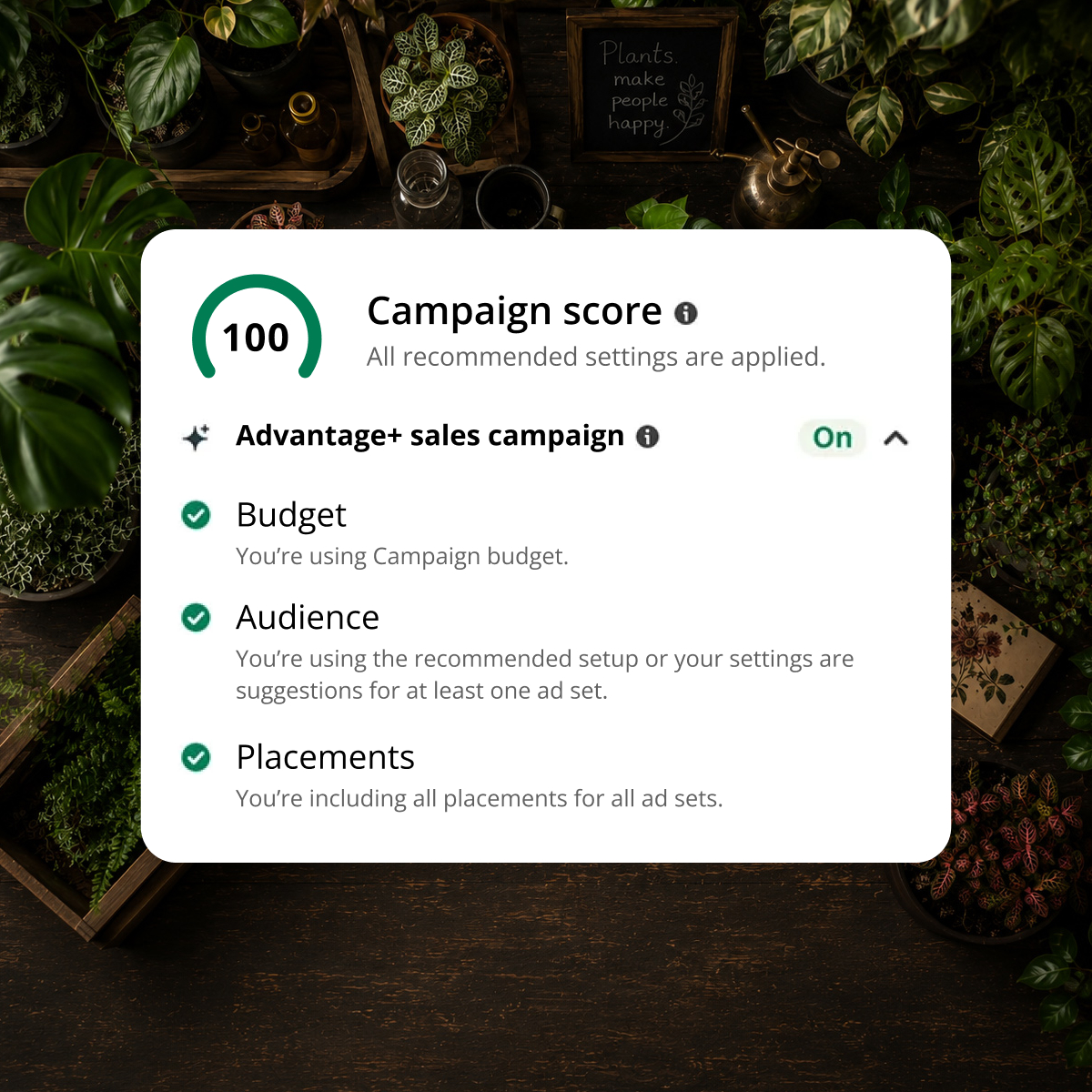
Campaign Scoring for Optimal AI-Powered Ad Performance
Campaign Scoring for Optimal AI-Powered Ad Performance
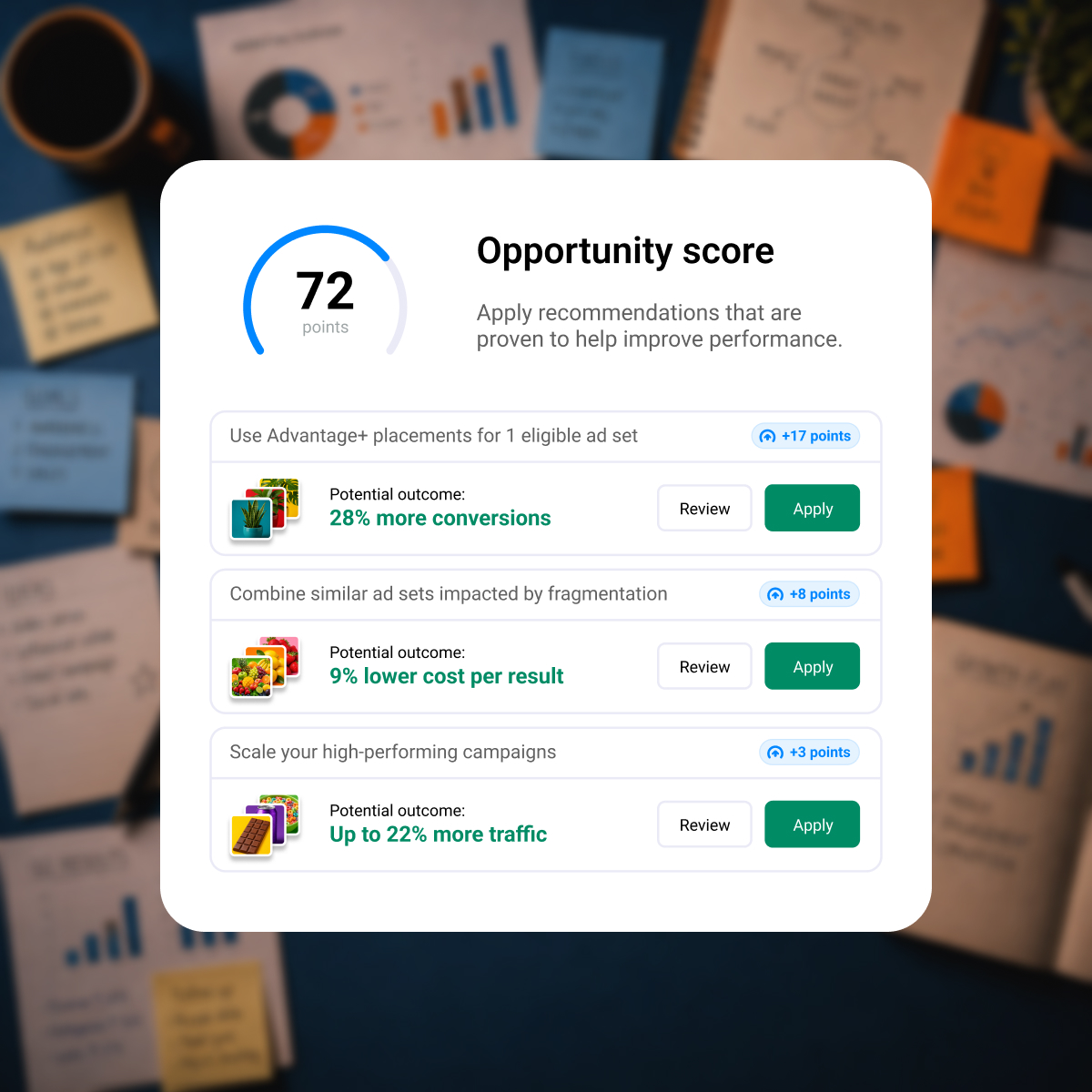
Ranking and Prioritization Framework