
Millions of advertisers were missing high-impact opportunities.
Opportunity Score
Role: Product design lead
Timeline: ~1.5 years
Team: Cross-org V-team. Product Design (5+), Content (3), Engineering (10+), Product Management, Data Science, Marketing, Sales, Design Systems, Art & Illustration
Ads Manager is used by over ten million advertisers to publish ads to almost four billion active monthly users across Facebook, Instagram, WhatsApp, Messenger, and Threads. After publishing ads, advertisers monitor their active ad campaigns, making optimizations and adjusting campaign characteristics to improve performance in key metrics. The system generates recommendations across Ads Manager, helping advertisers to improve performance. As recommendation inventories scaled, advertisers increasingly struggled to identify which actions mattered most. Opportunity Score introduced a unified prioritization framework that consolidated recommendations into a ranked, system-level optimization experience, helping advertisers focus on the highest-impact opportunities across the account.
I led product design across core experience strategy, ranking and prioritization, orchestration models, and scalable guidance frameworks used across the ecosystem.
Impact snapshot
Advertisers
10M+
Adoption lift
+27%
Guidance inventory
150+
Inventory growth
13x
Testing sessions
26
Problem
“How do I know which insight is truly valuable, in order to ensure I’m not missing the biggest opportunities for my business?”
Before
- Recommendations operated independently of one another
- Guidance lacked prioritization
- Recommendation inventory competed for attention
- Advertisers struggled to identify highest-impact actions
- Complexity gap grew as guidance inventory scaled
Opportunity
“Show me my next biggest opportunity to drive meaningful performance improvement across my entire advertising strategy.”
After
- Recommendations operate under a cohesive system
- Guidance is prioritized for business value
- Recommendations are focused on the biggest opportunities
- Highest-impact actions are always a click away
- Scalable frameworks enabled significant inventory growth
Objectives
For advertisers
Personalized insights
Create a scalable insights system that curates opportunities to make meaningful campaign performance improvements with personalized guidance.
For Meta
Scalable framework
Establish a framework that helps product teams across the organization to build their product knowledge into a cross-platform system.
For me
System-level design
Design a product system that transforms campaign optimization from fragmented guesswork into an outcome-focused workflow.


Constraint
Org complexity
I worked closely with product teams across org charts, surfaces, and platforms. Errors, warnings, performance recommendations, and guidance for audience, budget, placements, catalogs, creative, and more, were all built independently, with their own adoption goals, and unintentionally competed with one for the advertiser’s attention. The challenge was designing a unified experience, and creating a scalable system that could centralize these diverse actions into a cohesive cross-platform decision-making framework.

Solution
Opportunity Score's anatomy consists of two atomic elements.

Global account score
On a 0-100 point scale, the score represents how optimized an account’s campaigns, ad sets and ads are. It updates in real time, giving a clear understanding of the account’s health at a glance. A score of 100 represents an optimally-performing ad account, following all best practices.

Opportunities to raise the score
While campaigns are active, the system monitors for opportunities to improve ad delivery. When issues like fatiguing creative arise, the score drops below 100, and personalized resolutions are recommended with context rooted in true business impact.
Program details
My role
- Product experience leadership
Led product design across core Opportunity Score experiences within Ads Manager. - Recommendation mechanics
Ranking and scoring the highest-impact optimization opportunities and related feedback and learning loops. - Guidance orchestration
Framework for surfacing the highest-impact opportunities. - Cross-platform integration
Integrated across multiple platforms and surfaces, internal- and advertiser-facing. - Design governance
Guidance frameworks, prioritization standards, and consistency models supporting long-term ecosystem scale.
Design principles
- Prioritize clarity over volume
More guidance does not automatically create better outcomes. - Surface highest-impact actions first
Advertisers needed confidence in what mattered most and a simple path to act on it. - Create scalable patterns
The system needed to support rapidly expanding recommendation inventories built across the org. - Reduce cognitive overhead
Optimization workflows should feel focused, not overwhelming. - Never punitive
Advertisers feel validated for optimal setups, not punished for deviating from them.
The core experience
Campaign table: the highest traffic surface in Ads Manager
Framework role: Tactical campaign-level view into top opportunities across actively running ad campaigns.
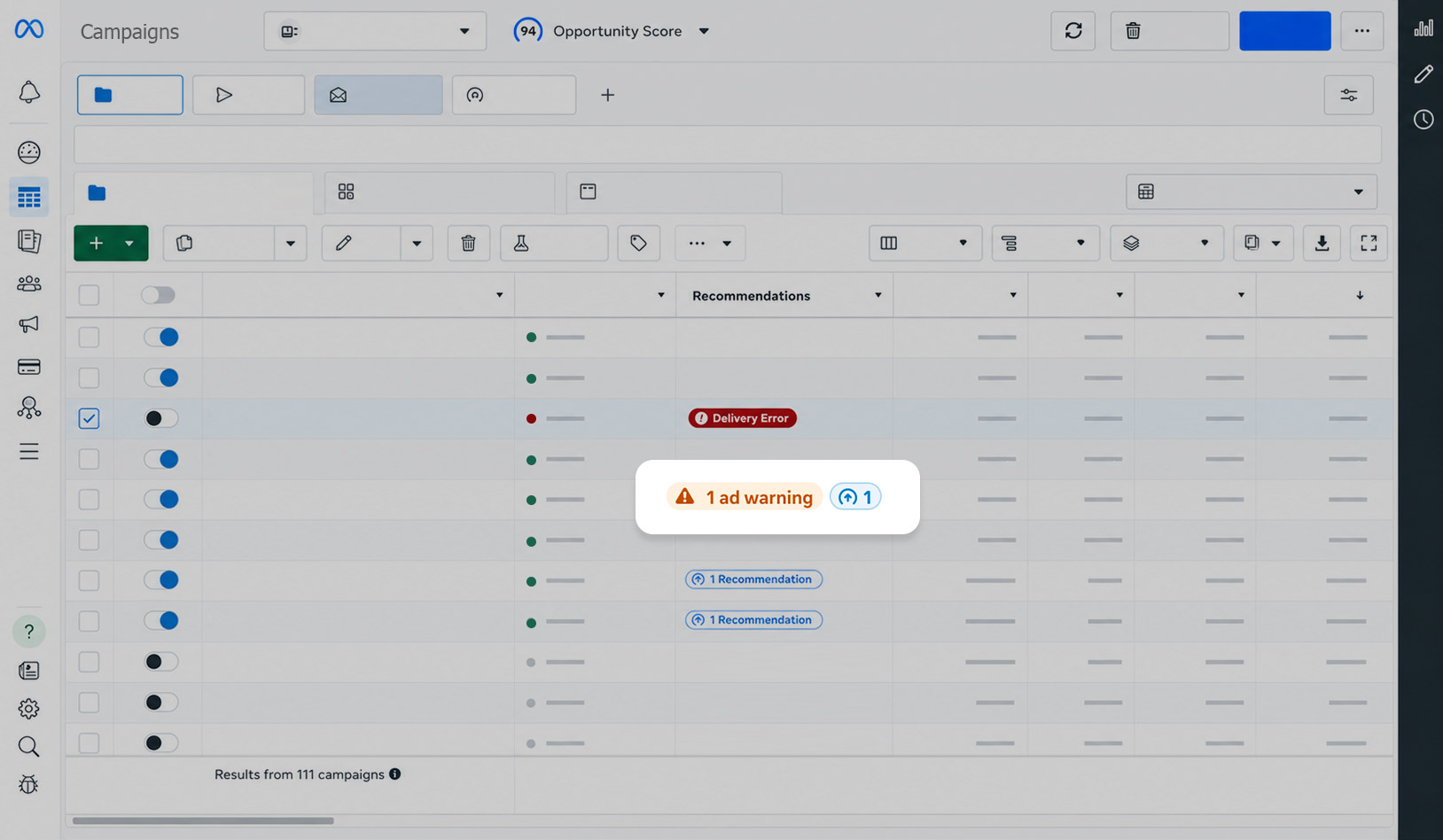
Campaign-level insights
Advertisers can always see where campaign-level opportunities exist.
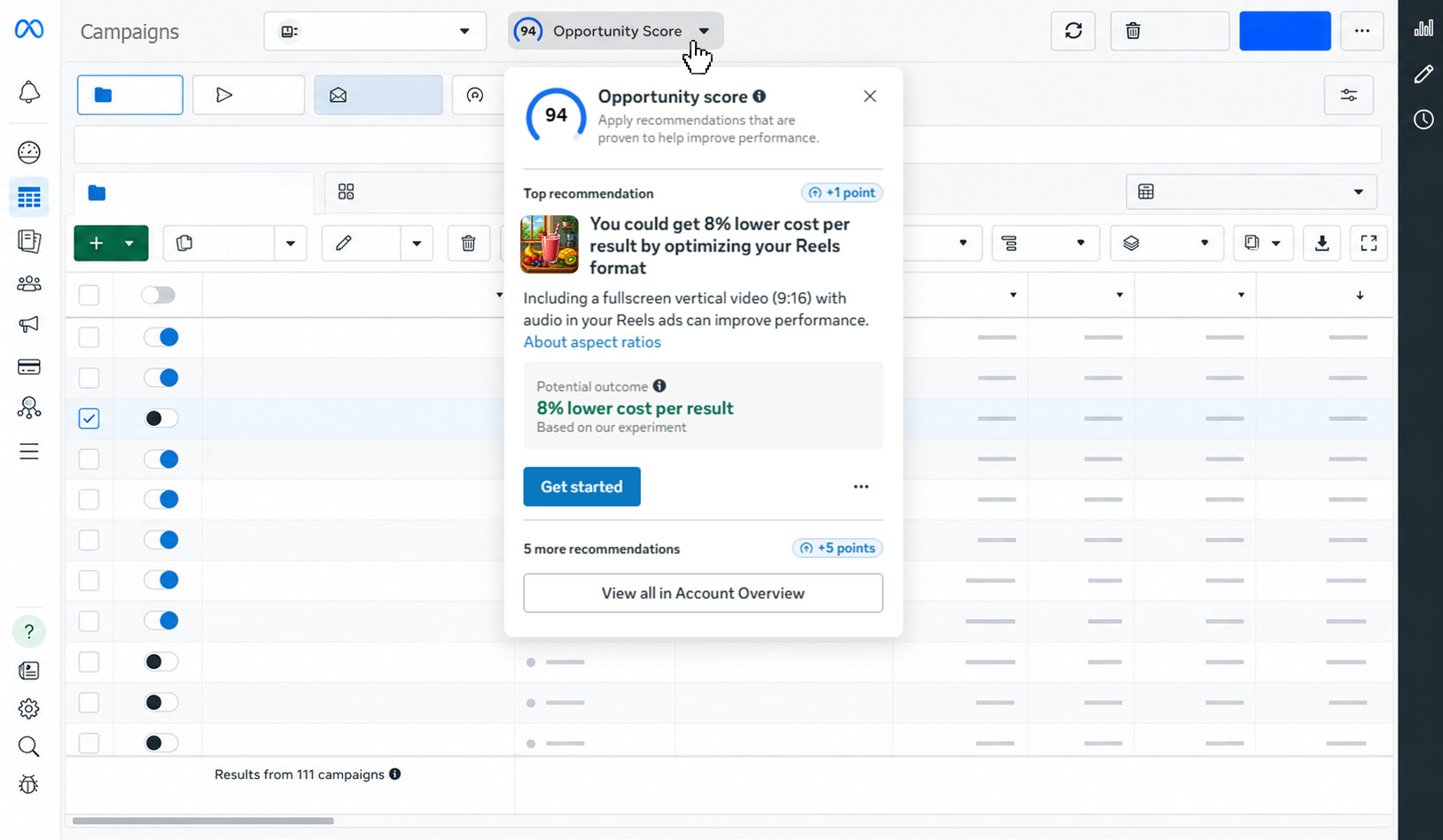
Top recommendations
Clicking on the score at any time shows the next best opportunity to drive true business impact.
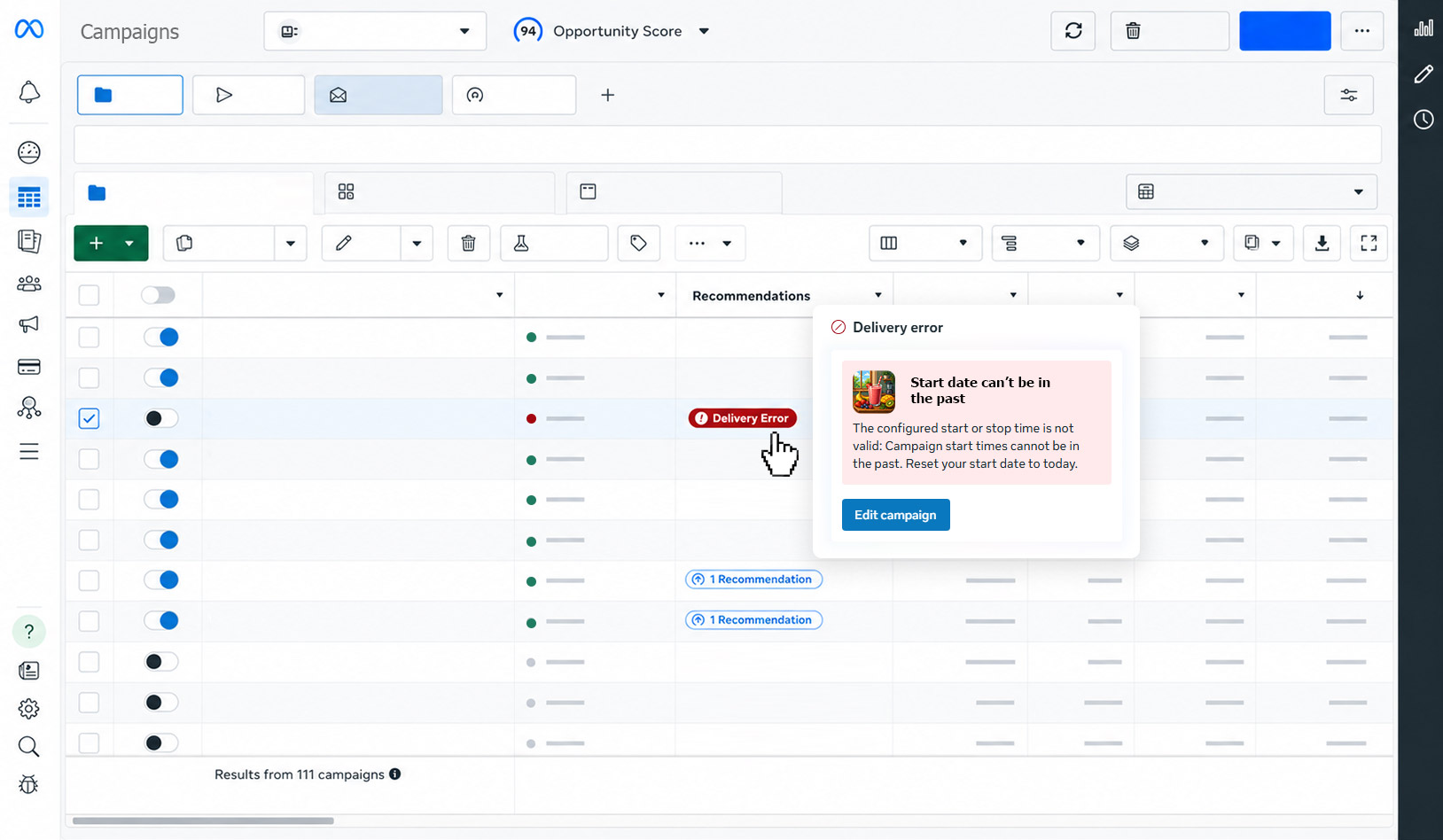
Campaign actions
Ranking and prioritization logic is used to highlight the biggest opportunities.
Account overview: account-wide value-ranked priorities
Framework role: Strategic opportunities across the account, ranked, prioritized, and personalized.
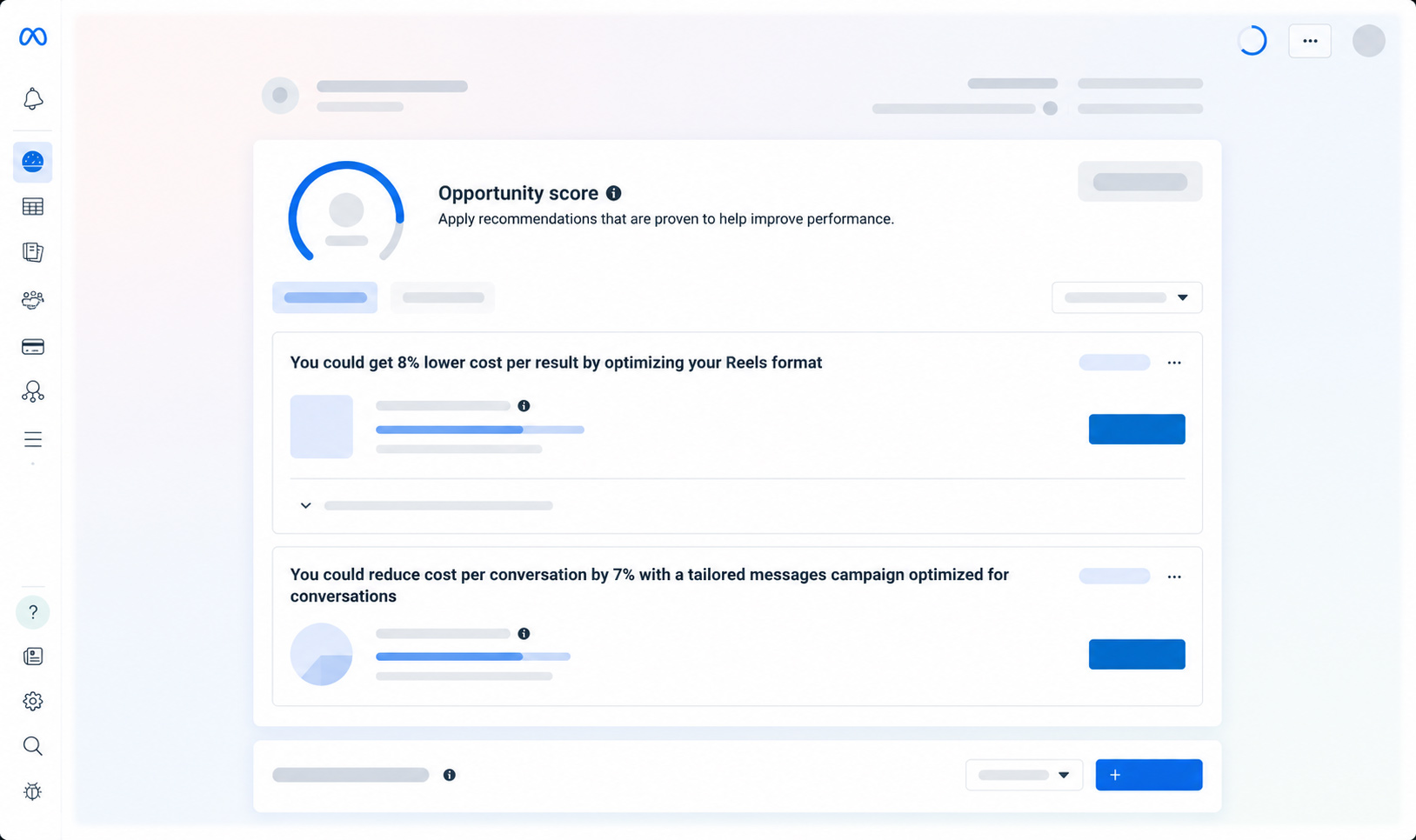
Ranking
Opportunities are personalized, and stack ranked by predicted value to the advertiser.
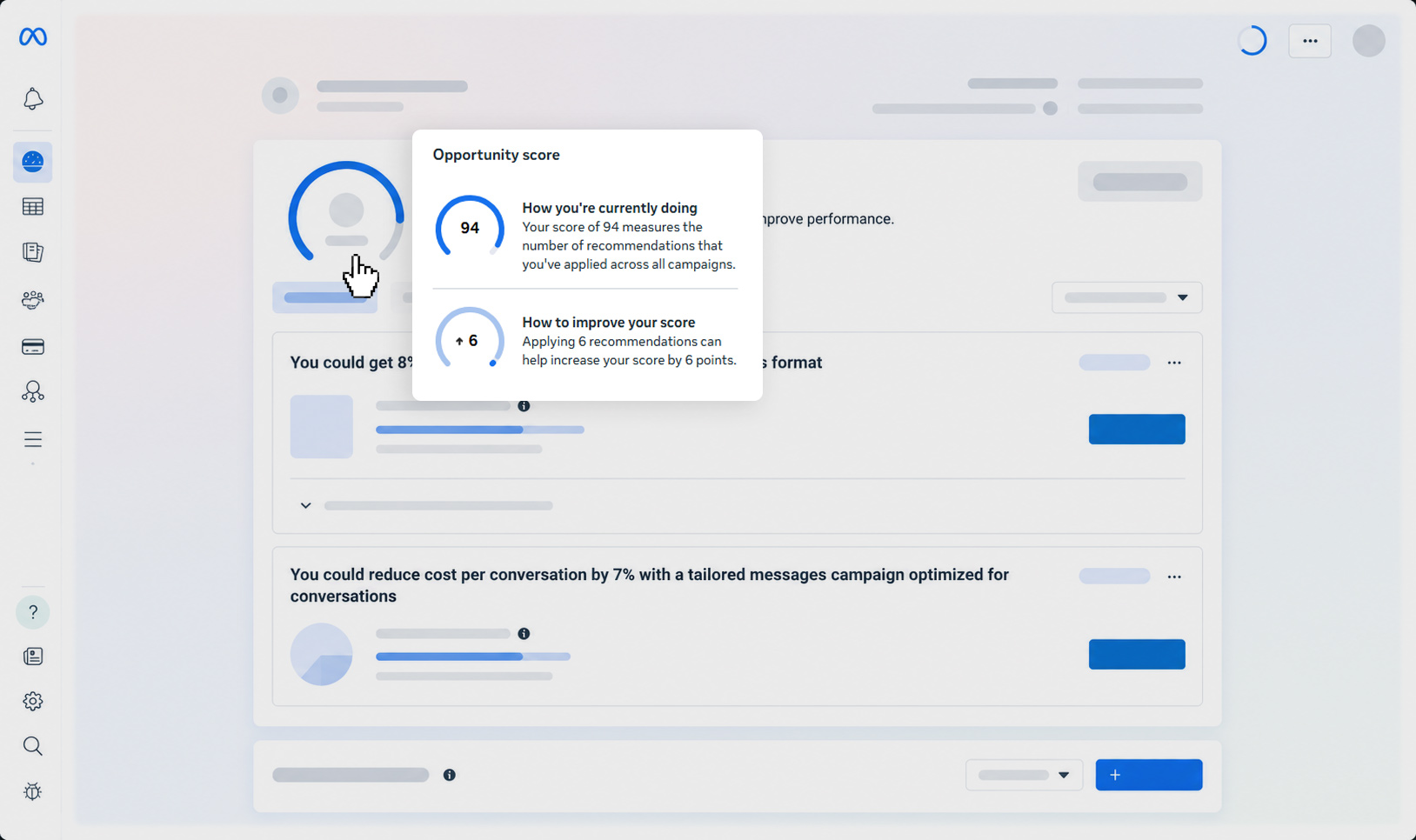
Contextualization
Explainability was a key design investment, to ensure insights are always presented in context.
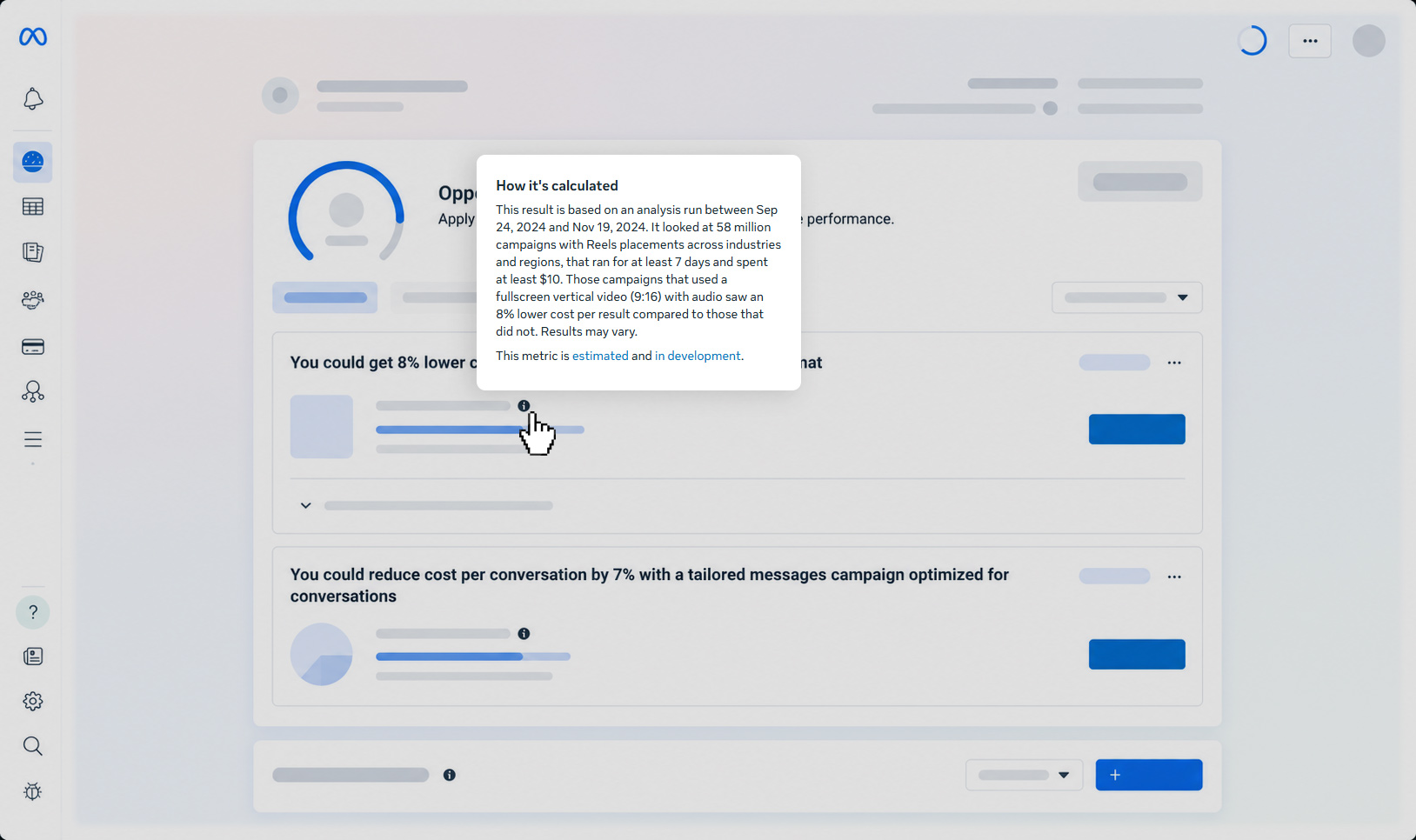
Trust
Improving trust was critical to adoption. Insights are always accompanied by statistical proof of value.
Visual design
I led art direction of the Opportunity Score brand across:
- Promotional marketing
- Social ads (Reels ads on Facebook and Instagram)
- Documentation and help center
- Illustration and art assets
- Design system integration
- Iconography, colors, and typography
- GTM assets
Visual language


Iconography

Scoring metaphors

Ingress points

Value markers
Design decisions
Orchestration
Insights ecosystem
To reduce conflicts and fragmentation, recommendations were designed to operate as a system, rather than as independent packages.
Framework scaling
The system was designed to support inventory growth without requiring entirely new interaction models or surface patterns.
Unified scoring model
Unified guidance under a centralized framework that prioritized opportunities through a shared scoring and ranking system.
Advertiser trust
Confidence through explainability
Makes system prioritization understandable and trustworthy. Recommendations included reasoning and actionable next steps.
True business outcomes
Recommendations were framed around projected performance improvements rather than abstract system health alone.
Validation, not punishment
Advertisers should feel rewarded for healthy campaign setups instead of pressured by punitive scoring mechanics.
Ranking
Impact over volume
Emphasizes the relative performance impact of each opportunity to guide focus on the most meaningful actions.
Progressive prioritization
Progressively elevates the most impactful opportunities first, simplifying decision making even in complex advertising environments.
Identify the next best action
Eliminates guesswork by helping advertisers quickly understand which action would create the highest-value incremental gain.
Outcomes
Advertiser outcome
Higher-confidence decision-making
Opportunity Score reduced guesswork by giving advertisers a prioritized plan, not just disconnected recommendations.
It empowered advertisers to make more informed decisions and understand the value of the system’s personalized insights. More importantly, advertisers no longer had to guess which optimizations would drive the greatest impact. They could focus on incremental optimizations that are proven to be the most impactful.
On average, advertisers who used Opportunity Score in their advertising strategy saw a 5% lower cost per acquisition, allowing budget scaling to high-performing ad campaigns.
Business outcome
Product adoption lift, >10x scaling
Opportunity Score created a scalable recommendation framework that product teams could plug into across Ads Manager.
The framework exceeded adoption targets in alpha, and drove measurable increases in campaign creation completion rates and advertiser engagement, growing from roughly ~10 inventory in alpha to to over 150 by global launch. The performance gains felt by advertisers had a significant effect, and led to statistically significant gains throughout the funnel (adoption → outcomes → revenue). In other words, as advertisers followed more recommendations, their ads performed better, and their spend on Meta ads grew.
Personal outcome
Promotion to staff product designer
Opportunity Score fundamentally changed how I think about product design at scale.
Working on this framework highlighted the importance of system thinking over product thinking, and that designing effective recommendation systems depends not only on reducing cognitive overhead and reducing underlying complexity, but on building trust in the system.
I learned how often products unintentionally “ship the org chart” to users, and the long term consequences this can have at scale. Simplifying complex organizational structures into cohesive user experiences prevents this common pitfall.
More work
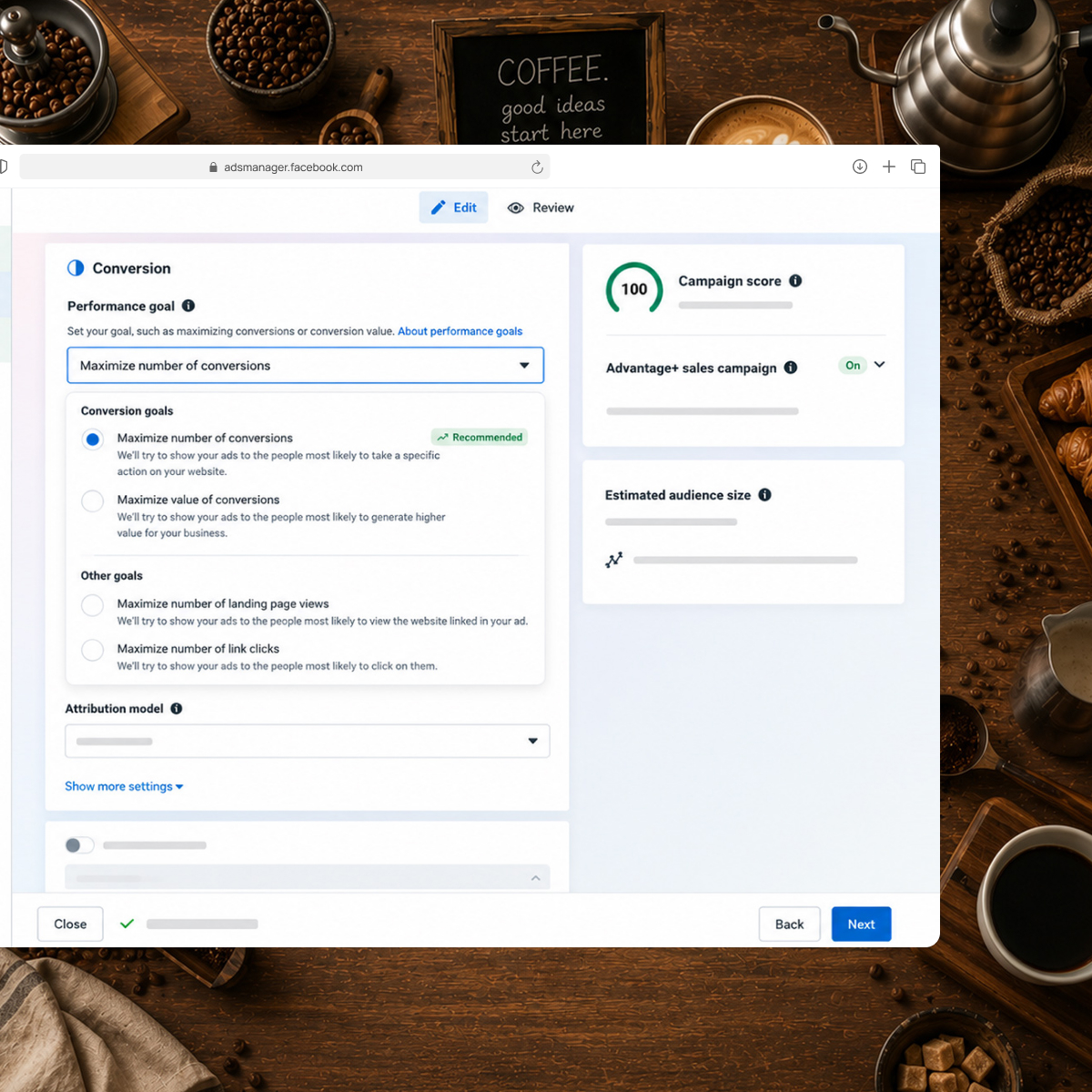
Goal Expression in Meta’s Ads Manager
Goal Expression in Meta’s Ads Manager
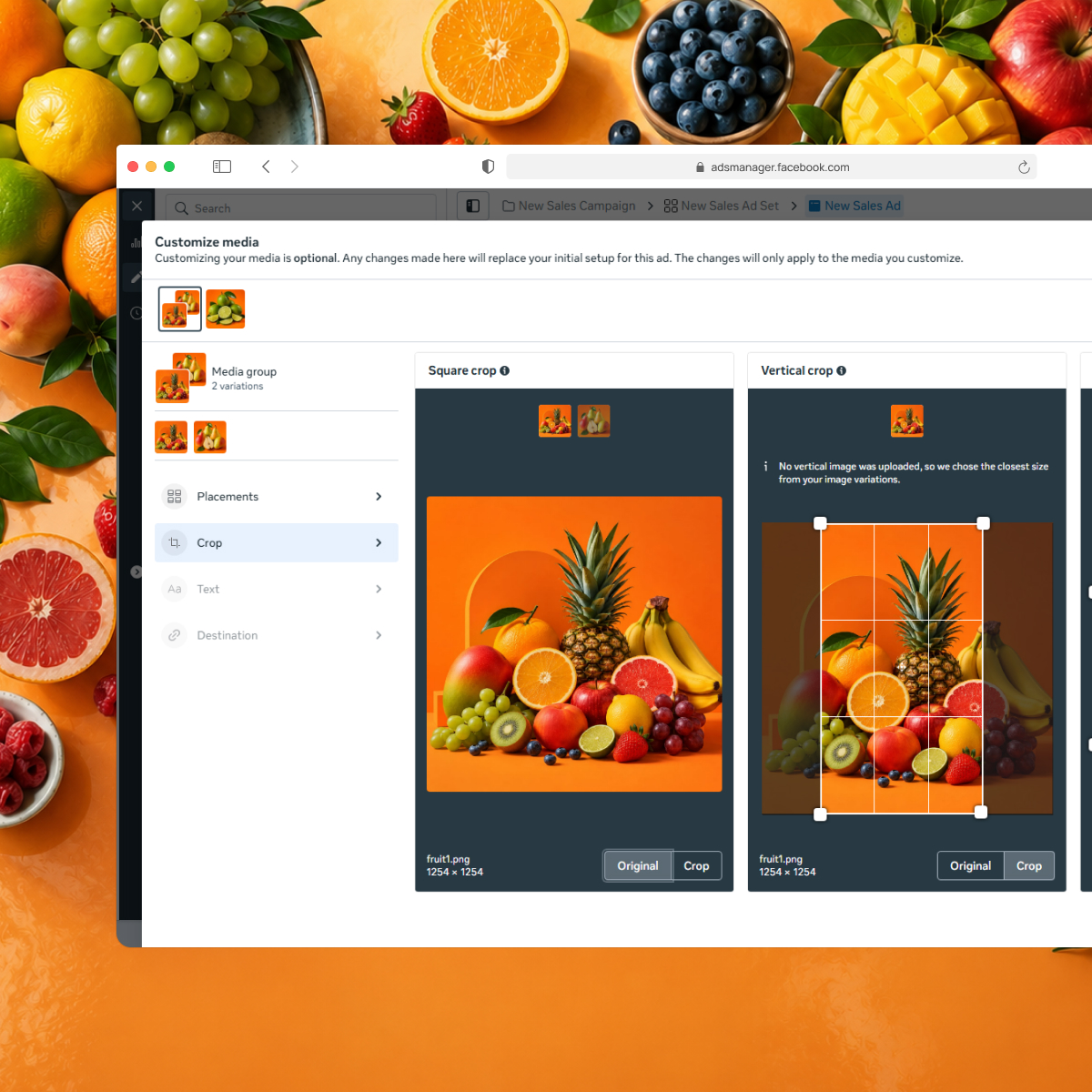
Ad Media Editing Controls
Ad Media Editing Controls

Ad Placement Settings in Meta’s Ads Manager
Ad Placement Settings in Meta’s Ads Manager

Campaign Scoring for Optimal AI-Powered Ad Performance